Löwenbräu: The Lion’s Legacy in a Glass
When I’m not busy with Ubuntu app testing, deep into a good book, or tending to plants in the garden, I like to wind down with a cold beer — especially one I haven’t tried before. Beer tasting has become a small ritual, blending curiosity and relaxation. And tonight’s pick is a classic from Munich: Löwenbräu Münchner Hell.
Here’s a fun twist — did you know Mötley Crüe took the “ö” in their name from this very beer? Back in their early days, they were drinking Löwenbräu and thought the umlaut looked cool. Rock ‘n’ roll meets Bavarian tradition — and behind that quirky detail lies one of the oldest and most iconic breweries in the world.

A Brew with History
The story of Löwenbräu — which means “lion’s brew” — begins as early as 1383 in Munich, making it one of the oldest beer brands still in existence. Though official records of the brewery under the Löwenbräu name date from 1746, it’s believed the beer was already being brewed and sold under the lion emblem for centuries. That lion, by the way, ties directly to the heraldry of Bavaria and the cultural pride of the region.
Löwenbräu quickly became a staple of Munich brewing, especially as the city established its reputation as a beer capital. It was one of the six breweries allowed to participate in the original Oktoberfest and remains a major presence there today. By the 19th century, Löwenbräu had embraced industrial-scale brewing, becoming one of Germany’s biggest exporters — especially to the U.S., where it enjoyed a wave of popularity in the 1970s and 80s.
Modern Times and Global Reach
As the beer industry modernized, so did Löwenbräu. In the late 20th century, the brewery went through several corporate changes, including a notable partnership with Miller Brewing in the U.S., which brewed Löwenbräu domestically for the American market.
However, purists argued that the American version didn’t quite capture the Bavarian soul of the original. Eventually, the rights and recipe returned to German hands.
Today, Löwenbräu is part of the Anheuser-Busch InBev group, but it remains brewed in accordance with the Reinheitsgebot — the Bavarian Purity Law of 1516 — which permits only water, barley, hops, and yeast.
Despite its corporate evolution, the beer has stayed true to its traditional profile, maintaining its identity as a staple of Münchner Helles — the classic pale lager from Munich.
Taste Notes (From a Non-Expert)
Now, I’m no professional beer taster — no diploma in hops, no fancy vocabulary. But here’s how I’d describe Löwenbräu Münchner Hell after a quiet evening with it:
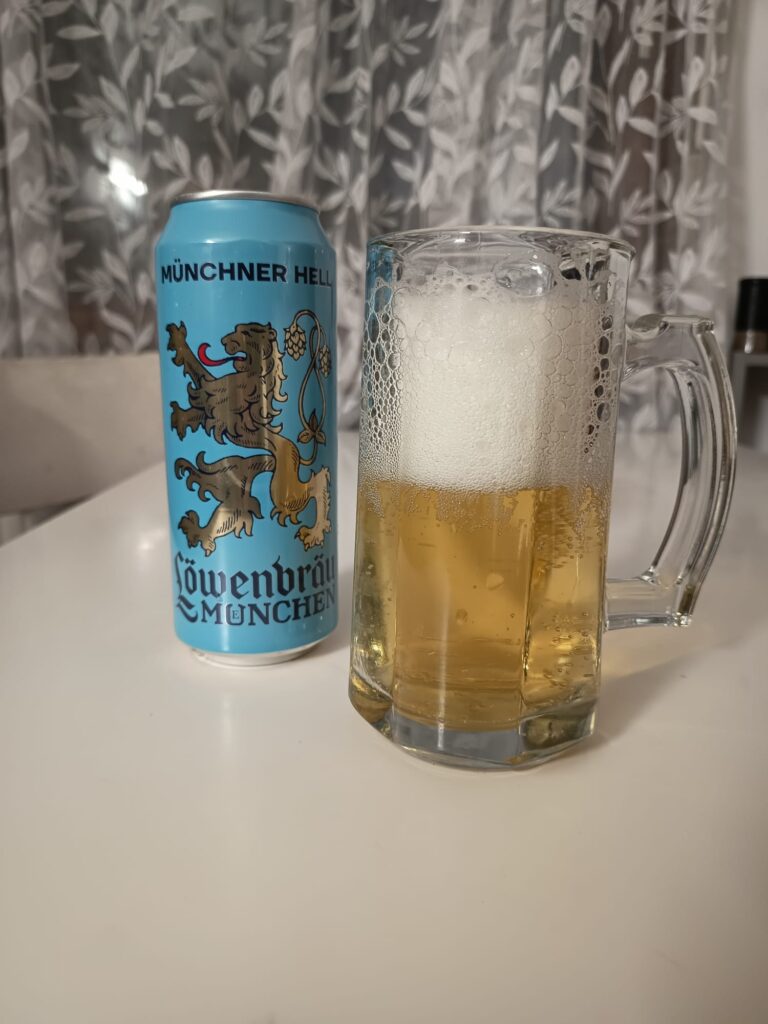
It pours a clear golden yellow, with a generous white foam that holds nicely. The first sip is clean and smooth, with a mild malt sweetness up front, quickly balanced by a soft bitterness. There’s a kind of fresh-baked bread note, typical of good Bavarian lagers, and maybe just a hint of herbal hop in the finish. It’s refreshing, not heavy, and incredibly easy to drink — the kind of beer that feels familiar, even if it’s your first time trying it.

Conclusion
Drinking Löwenbräu feels a bit like stepping into a piece of history — not in a dramatic, grandiose way, but in the quiet comfort of something well made and time-tested. It doesn’t try too hard. It doesn’t need to.
There’s something deeply satisfying about sipping a beer that has been brewed in the same city for centuries, enjoyed by kings, workers, festivalgoers, and yes — even rock bands.
For me, Löwenbräu isn’t about chasing rare brews or extreme flavors. It’s about enjoying a cold glass at the end of a day, appreciating the craft behind it, and knowing that sometimes, the best things are the ones that have stood the test of time — lion and all.

3 thoughts on “Löwenbräu: The Lion’s Legacy in a Glass”